TD Clear with $1,000 Credit Limit Review: Predictable Fees for Balance Management
Tired of unpredictable credit card interest? The TD Clear Card replaces variable APRs with a flat $10 monthly fee, offering transparent balance management, but is it worth the cost?
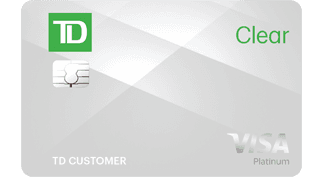
| Annual Fee | $0.00 |
| Sign-up Bonus | No signup bonus |
| Rewards Rate | No rewards rate |
| Other Fees | Monthly Fee $10 Monthly Membership Fee ($120 annualized) Balance Transfer Fee $0 Cash Advance Fee $0 Annual Fee None Foreign Transaction Fee $0 Late Payment Fee $0 Returned Payment $0 |
Overview
The TD Clear with $1,000 Credit Limit offers a unique approach to managing credit by swapping a traditional interest rate for a simple, predictable fee structure. Instead of a variable APR, cardholders pay a flat $10 monthly fee. This makes it an intriguing option for those who tend to carry a balance and want to know exactly what their costs will be each month. The card also eliminates several common pain points by charging no late payment fees, no foreign transaction fees, and no cash advance fees, further enhancing its appeal for consumers who value simplicity and predictability above all else.
However, this simplicity comes at a cost. The $10 monthly fee adds up to $120 per year, which is a significant price for a card that offers no rewards, no sign-up bonus, and a modest credit limit. If you pay your balance in full each month, you'll be paying for a feature you don't use, making other no-annual-fee cards a far better choice. The lack of any rewards program means you won't earn cash back or points on your everyday spending.
Ultimately, the TD Clear card is a niche tool designed for a very specific user. It’s best for individuals with fair credit who need a straightforward way to manage a revolving balance without worrying about compounding interest. If you prioritize predictable payments and are looking for a simple financial product to help build or manage your credit, this card could be a good fit. However, if you're looking to earn rewards or avoid fees entirely, you'll want to look elsewhere.
Pros & Cons
What's great
- No annual fee
- No foreign transaction fees
- No late payment fees
Things to consider
- No sign-up bonus
- No rewards
- Monthly membership fee
Benefits
The primary benefit of the TD Clear card is its unique and straightforward fee structure, designed for those who value predictability. Instead of a variable interest rate (APR), the card charges a simple, flat monthly fee. This can be a significant advantage if you tend to carry a balance, as you'll always know exactly what your financing cost is, preventing the shock of compounding interest that can quickly escalate on traditional credit cards.
Fee-Friendly Features
Beyond its core structure, the TD Clear card eliminates several common penalty fees that trip up many cardholders. You won't be charged a late payment fee, which provides a valuable safety net if you miss a due date. It also forgoes foreign transaction fees, making it a surprisingly decent option for purchases outside the U.S. or from international online retailers. While the card doesn't offer rewards, it does come with standard Visa benefits, including cell phone protection (when you pay your bill with the card) and Visa Zero Liability protection against unauthorized charges.
Drawbacks
The most significant hurdle for the TD Clear card is its cost relative to its benefits. While it's advertised with no annual fee, it charges a $10 monthly membership fee, which adds up to $120 per year. This is a steep price for a card that offers no rewards program whatsoever — no cash back, points, or miles on your spending. Furthermore, the lack of a sign-up bonus means there's no initial value to help offset this ongoing cost. For anyone who pays their balance in full each month, this card represents a net loss, as you're paying a fee without earning anything in return.
The card's primary feature is its 0% APR, which is replaced by the predictable monthly fee. However, it's crucial to understand the trade-off. On its $1,000 credit limit, the $120 annual cost is equivalent to a 12% APR. This structure is only beneficial for individuals who consistently carry a balance and would otherwise face a much higher interest rate. For those with good credit who can qualify for other cards, or for anyone who avoids carrying debt, a traditional no-annual-fee credit card would be a far more valuable and cost-effective choice.
Decision Guidance
This card is a niche tool for individuals who consistently carry a balance and value predictable costs over earning rewards. The flat $10 monthly fee simplifies debt management by eliminating compounding interest, but it becomes an expensive $120 annual cost if you pay your bill in full each month. If you're looking for rewards or you don't carry a balance, a no-annual-fee credit card will be a much better value.
Summary
By swapping a traditional APR for a simple $10 monthly fee, the TD Clear card offers a uniquely predictable way to manage a revolving balance without surprise interest charges. While this simplicity can be valuable for those who consistently carry a balance and prioritize known costs, the card's $120 effective annual fee and complete lack of rewards make it a poor choice for anyone who pays in full or wants to earn something back on their spending.